
EEC participants continue to expand renewable energies
In its annual report, EEC reveals the progress made by Swiss providers of publicly relevant services in the areas of energy and climate. In the reporting year 2024, these participants increased the share of renewable energies in their total energy consumption from 65% to 69%. By doing so, they are making an important contribution to the energy transition in Switzerland.
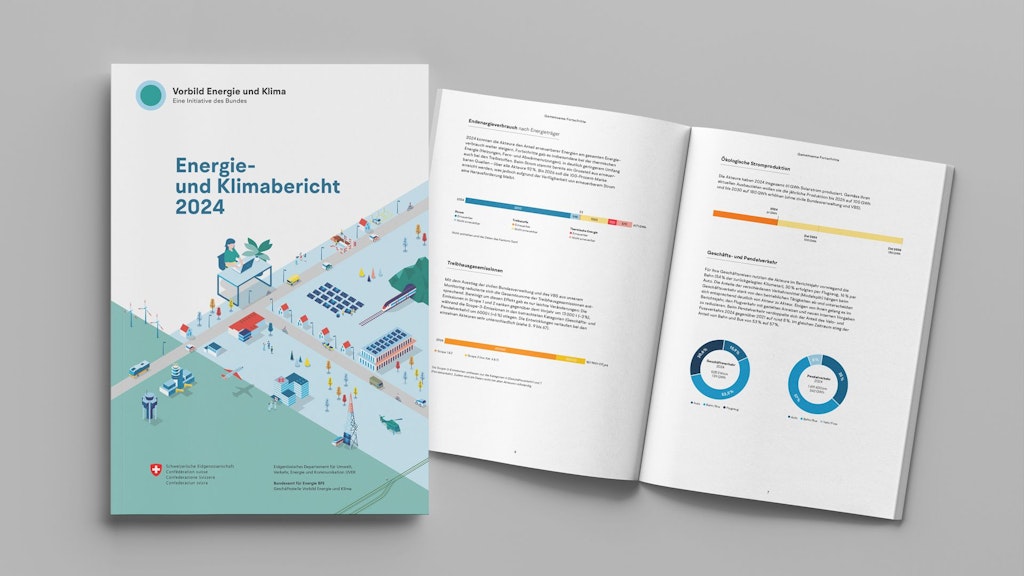
In total, the EEC participants' final energy consumption in 2024 was around 6170 GWh, of which 4230 GWh (just under 69%) came from renewable sources. Fossil energies accounted for only 31% (35% in the previous year). Progress was made in particular in thermal energy (heating and waste heat recovery), and to a much lesser extent also in transport fuels. A large proportion of electricity already comes from renewable sources – 92% across all participants. The aim is to reach the 100% mark by 2026, but this remains a challenge due to the availability of renewable electricity.
Stagnating greenhouse gas emissions
There were only slight changes in greenhouse gas emissions in 2024: Scope 1 and 2 emissions fell by 13,000 tonnes (-3%) compared with the previous year. Trends vary greatly among the individual participants.
More self-generated solar power
By participating in the EEC, the participants have also pledged to install additional photovoltaic systems. In 2024, they produced a total of 61 GWh of solar power. This is equivalent to the average electricity consumption of a Swiss town with 10,000 to 12,000 inhabitants. They want to increase annual production to 100 GWh by 2026, and to 180 GWh by 2030.
Business travel most often by rail
In the year under review, participants continued to predominantly travel by train (54% of the kilometres travelled), 30% by plane and 16% by car for their business trips. In the case of business travel, the rates at which they used different modes of transport (modal split) depend heavily on the individual participants' operational activities and therefore differ significantly from one participant to the next. Some participants succeeded in reducing air traffic in the reporting year with targeted incentives and new internal regulations.
In terms of commuter traffic, the share of bicycle and pedestrian traffic doubled in 2024 compared with 2021 to around 8%. In the same period, the share of rail and bus use increased from 53% to 57%.
In the report, the providers of publicly relevant services also disclose the extent to which they have implemented the 15 joint measures. They made the greatest progress in energy-efficient new buildings and in integrating existing IT operations into central, resource-saving data centres.